
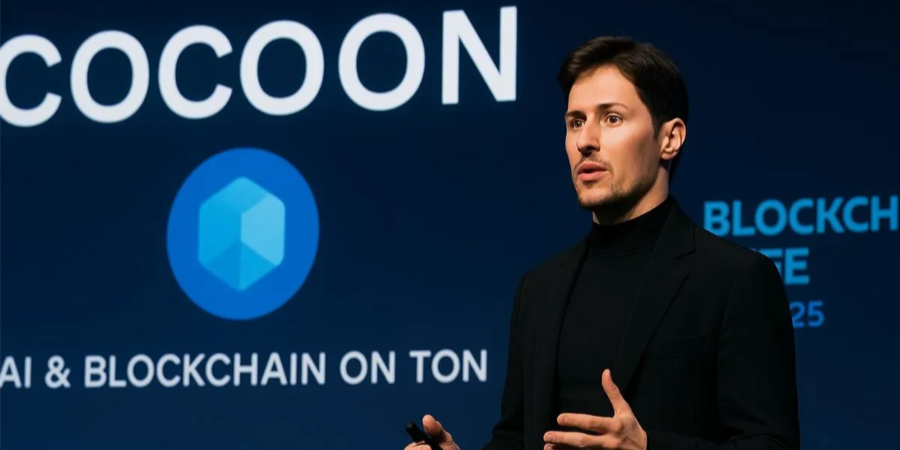

Decentralized AI is no longer a fringe concept—it is becoming the next frontier of digital infrastructure. And while Silicon Valley giants race to centralize machine intelligence inside proprietary clouds, Pavel Durov has been quietly engineering a counter-movement. Behind Telegram’s familiar blue interface, Durov has spent years assembling what many insiders now describe as a “parallel AI empire”—one built not on central servers but on distributed compute, crypto-native incentives, and user-owned data rails.
This investigation explores how Durov’s strategy evolved, why decentralized AI aligns with his long-standing ideology, and how this emerging ecosystem positions him at the center of a global power shift in artificial intelligence.
The Ideological Roots of Durov’s Decentralized AI Vision
To understand why Pavel Durov became one of the world’s most influential advocates for decentralized AI, you have to look back at his history. Durov has built his career on resisting control—first during his time battling Russian authorities at VK, then through Telegram’s longstanding refusal to hand over user data to governments.
Decentralized AI fits neatly into this philosophy. Rather than training and deploying models on monolithic servers owned by a corporation, decentralized AI distributes compute across thousands of independent nodes.
This structure provides:
- Censorship resistance
- Stronger data privacy protections
- Lower entry barriers for developers
- Community-owned infrastructure
Where OpenAI, Google, and Anthropic are constructing centralized AI fortresses, Durov is trying to build a people-powered alternative—one that cannot be shut down, bought out, or politically captured.
Telegram’s Network—A Hidden Advantage in Decentralized AI
Telegram’s 900+ million users represent one of the largest distribution platforms for decentralized applications in the world. What few observers realized was that its infrastructure also provided a perfect launchpad for AI systems built on decentralized principles.
TON: The Blockchain Backbone of the Strategy
TON—the blockchain originally designed for Telegram—became the core of the decentralized AI architecture.
Its features include:
- Massively scalable sharding
- Low-cost transactions
- High throughput
- Native support for micropayments
These capabilities make TON an ideal base layer for an AI compute marketplace where millions of micro-tasks—training cycles, inference calls, model hosting—can be tokenized and traded.
In 2024–2025, TON became one of the fastest-growing blockchain ecosystems, and Durov quietly aligned it with a mission larger than payments or gaming: a decentralized AI supernetwork.
The Cocoon Initiative—Durov’s Most Ambitious Move Yet
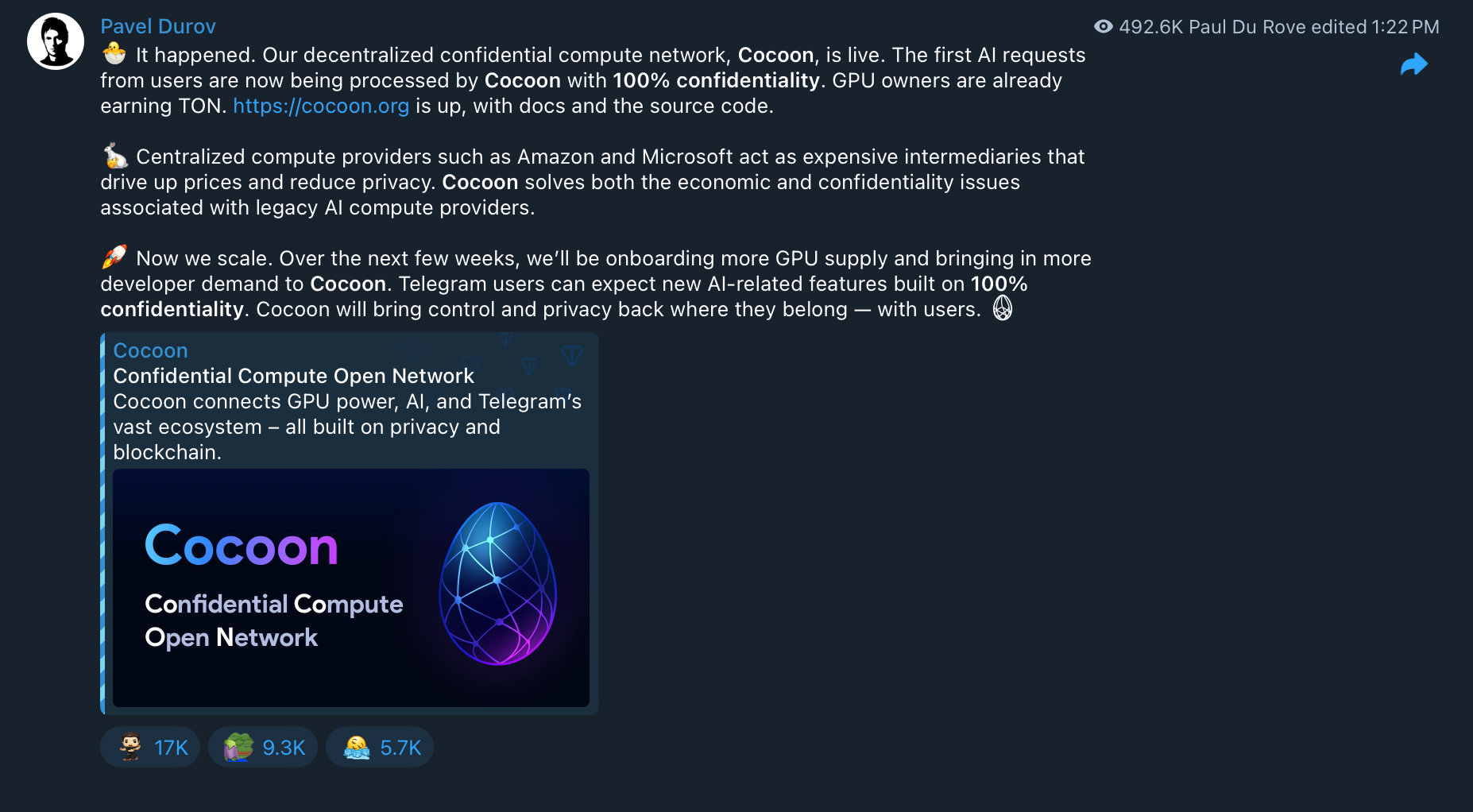
In 2025, the public finally caught a glimpse of Durov’s endgame when the Cocoon decentralized AI network launched. Marketed initially as an alternative to compute clouds, Cocoon introduced something far more disruptive:
A permissionless, crypto-incentivized global market for AI computation and data.
How Cocoon Works Behind the Scenes
Cocoon coordinates three layers:
- Compute Nodes – Users contribute hardware power (GPUs, CPUs) and earn tokens.
- Model Layer – Developers upload models that become accessible across the entire network.
- Application Layer – Mini apps built inside Telegram or TON-based platforms leverage these models.
Rather than one corporation owning the servers, the public becomes the infrastructure.
This is the purest form of decentralized AI: millions of distributed machines functioning as a single intelligent organism.
The Quiet Partnerships: Suppliers, Validators, and AI Labs
Several AI labs and hardware suppliers began collaborating with Cocoon long before the public launch. While most deals remained discreet, industry sources have confirmed partnerships tied to:
- GPU-sharing startups
- Distributed compute networks
- Open-source AI research groups
- TON ecosystem validators
These alliances allowed Durov to quietly assemble a decentralized AI ecosystem years ahead of the industry narrative.
Two external validations add credibility to the strategy:
• MIT Technology Review has consistently highlighted the inevitability of distributed AI compute.
• Stanford’s Center for Research on Foundation Models has warned about centralization risks and the need for open alternatives.
These insights reinforce the strategic timing of Durov’s ecosystem.
How Durov’s Decentralized AI Empire Compares to Competitors
Below is a comparison between Pavel Durov’s decentralized AI ecosystem and a leading centralized competitor, such as OpenAI.
| Feature | Durov’s Decentralized AI (TON/Cocoon) | OpenAI (Centralized) |
|---|---|---|
| Architecture | Fully decentralized compute network | Centralized data centers |
| Governance | Community + token-based | Board + investors |
| Data Ownership | User-controlled | Corporation-controlled |
| Scalability | Horizontally distributed | Limited by server capacity |
| Access | Open, permissionless | Restricted via API pricing |
| Costs | Market-driven | Set by provider |
This contrast highlights the philosophical and structural gulf between the two ecosystems.
Why Decentralized AI Became a Global Power Play
While decentralized AI aligns with Durov’s philosophical roots, it also positions him at the center of a geopolitical contest. Centralized AI models depend heavily on U.S. or Chinese cloud infrastructure—politically sensitive territory.
A decentralized AI network, however, is:
- Borderless
- Harder to regulate
- Harder to sanction
- Resistant to corporate buyouts
This is why several governments have recently begun examining decentralized AI models: they challenge both Big Tech and state power simultaneously.
Durov’s system offers a new form of digital sovereignty—one that doesn’t rely on national borders.
Challenges Facing Durov’s Decentralized AI Vision
No decentralized AI network is without obstacles. The top concerns include:
1. Quality Control Across a Distributed Network
Ensuring accuracy, uptime, and reliability across thousands of nodes remains a technical challenge.
2. Regulatory Pressure
Governments may attempt to regulate AI compute, regardless of its decentralized nature.
3. Competition from Traditional AI Giants
OpenAI, Google, Meta, and others will not easily relinquish control of the AI landscape.
4. Sustainability and Incentive Models
Token-based reward systems must remain economically viable over time.
Yet despite these challenges, Cocoon has reached usage numbers that suggest the model is working.
The Future of Decentralized AI Under Durov’s Leadership
Industry analysts now believe Durov has constructed the most advanced and scalable decentralized AI ecosystem in the world. While competitors have prototypes or academic frameworks, Durov has:
- A blockchain tailored for scale
- A messaging app with near-billion-user distribution
- A thriving mini-app marketplace
- A global user base accustomed to crypto payments
- And now, a decentralized AI cloud (Cocoon)
This convergence gives him an advantage that no other AI leader currently possesses.
FAQ — Decentralized AI Explained
Q1: What is decentralized AI in simple terms?
Decentralized AI refers to AI systems that run on distributed networks rather than centralized servers, giving users more control over data and compute.
Q2: Why is decentralized AI important for privacy?
Because decentralized AI distributes computation across independent nodes, no single entity owns or controls user data, making privacy breaches far less likely.
Q3: How does Pavel Durov use decentralized AI in his ecosystem?
Durov integrates decentralized AI through the TON blockchain and platforms like Cocoon, allowing users to contribute compute power and build applications without centralized control.
Q4: Is decentralized AI more secure than traditional AI models?
Decentralized AI can be more resilient against shutdowns or censorship, though security depends on protocol design and node integrity.
Conclusion: The Silent Rise of a New AI Superpower
Pavel Durov has not made loud public announcements, nor has he waged PR wars like his Silicon Valley counterparts. Instead, he has taken a methodical, long-term approach—building infrastructure, acquiring users, decentralizing control, and enabling a new class of AI applications to flourish.
If centralized AI is the modern equivalent of a corporate oligarchy, then decentralized AI represents the digital commons. And Durov, intentionally or not, has positioned himself as its most influential architect.
As AI becomes a foundational layer of human society, the world may discover that the most important AI empire was not built in San Francisco—but quietly, globally, and decentralized across millions of devices.
