
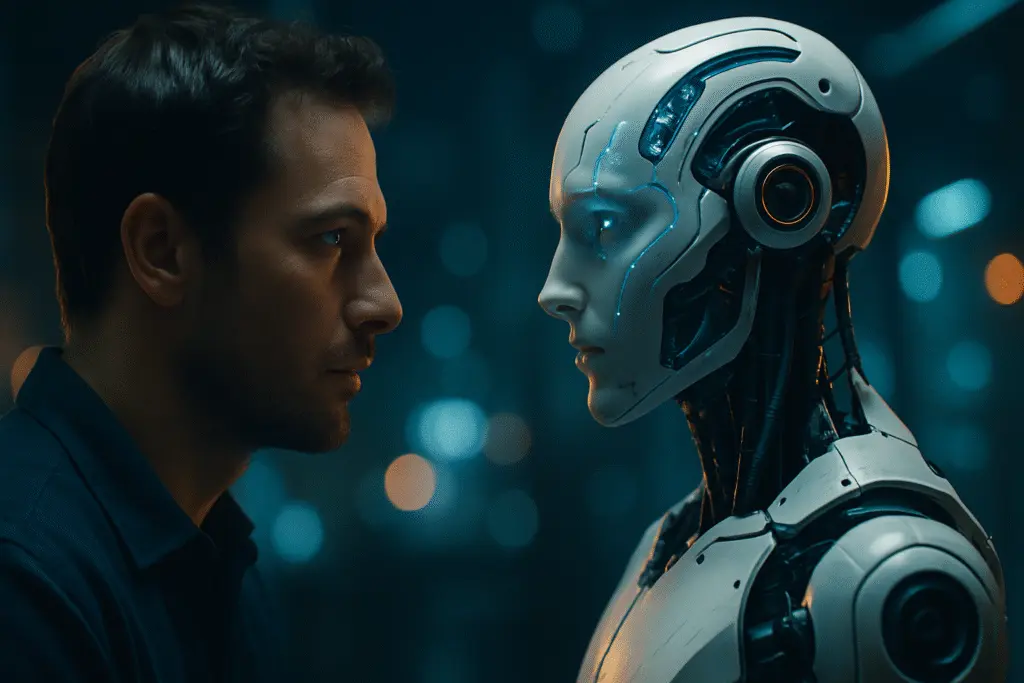

Can AI ever think like a human? This question has fascinated computer scientists, philosophers, and futurists for decades. From the early ambitions of Alan Turing to today’s breakthroughs in machine learning and large language models, artificial intelligence continues to narrow the gap between machine processing and human reasoning. Yet, the core debate remains unresolved: are machines simply mimicking patterns of thought, or are they on a trajectory toward genuine human-like cognition?
This investigative analysis explores the science, limitations, and philosophical questions surrounding whether AI can truly think like us—or if it will always remain an imitation.
Understanding Human Thinking vs. Machine Intelligence
What Makes Human Thought Unique?
Human thinking is not just computation—it is contextual, emotional, and deeply tied to our biology. The human brain processes information through approximately 86 billion neurons, forming dynamic connections that shape memory, creativity, and consciousness. Unlike algorithms, humans operate with intuition, abstract reasoning, and self-awareness.
How AI Thinks Today
Current AI systems, such as deep learning models, function by analyzing data, recognizing patterns, and predicting outcomes. According to MIT Technology Review, these systems excel at narrow tasks like image recognition or language translation but lack the broader adaptability of human cognition. While AI can outperform humans in specific domains, it does not yet possess self-awareness or emotional intelligence.
The Evolution of AI Toward Human-Like Thought
The Early Visionaries
Alan Turing’s famous Turing Test asked whether machines could imitate human responses convincingly enough to fool people. This test, proposed in 1950, still frames much of the debate around whether AI can ever think like a human.
Breakthroughs in Machine Learning
With the advent of neural networks and natural language processing, AI began to show remarkable capabilities. Modern systems like GPT and Google’s DeepMind AlphaGo have demonstrated that machines can learn strategies and language patterns at a scale previously thought impossible.
Yet, despite these advances, experts like Gary Marcus argue that today’s AI lacks the reasoning abilities required to achieve genuine understanding (Scientific American).
Where AI Excels—and Where It Falls Short
Areas Where AI Mimics Human Thinking
- Language Processing: AI chatbots can generate human-like dialogue.
- Strategic Gameplay: Systems like AlphaGo display advanced problem-solving.
- Medical Diagnosis: AI identifies patterns in medical imaging more accurately than many doctors.
Fundamental Gaps Between AI and Humans
- Emotional Intelligence: AI cannot feel emotions, only simulate responses.
- Consciousness: Machines do not possess subjective awareness.
- Common Sense: While humans apply contextual knowledge effortlessly, AI often struggles with nuance.
Can AI Ever Think Like a Human? Philosophical and Scientific Views
The Functionalist Argument
Some philosophers argue that if a machine can replicate the functions of thought—reasoning, learning, and adapting—it effectively “thinks.” Under this view, AI that passes advanced cognitive tests could be said to think like a human.
The Biological Argument
Others insist that human thought is inseparable from the brain’s biology and consciousness. According to neuroscientists, replicating human-like thought may require more than algorithms—it might require replicating the structures of human neurology.
Hybrid Possibilities
Emerging research in neuro-symbolic AI suggests combining deep learning with symbolic reasoning could lead to more human-like intelligence. These systems attempt to merge the raw processing power of AI with rule-based reasoning that mimics human logic.
Practical Implications for Society
AI in the Workplace
If AI ever begins to think like a human, the implications for industries such as law, medicine, and education would be profound. Roles requiring reasoning and judgment could shift dramatically.
Ethical and Legal Considerations
Should a machine that can think like a human have rights? How do we regulate AI decision-making in critical systems like justice or defense? These questions will only grow in importance as AI advances.
Risks of Anthropomorphizing AI
Experts warn against attributing human traits to machines prematurely. Treating AI as conscious when it is not can create misplaced trust and significant risks in areas like autonomous weapons or misinformation.
Internal Implications for AI Development
For readers exploring AI more deeply, you may also want to review our article on AI governance frameworks and our analysis of ethical AI investment. Both provide context for how society manages the path toward more human-like AI.
FAQs: Can AI Ever Think Like a Human?
1. Can AI ever think like a human in the future?
While AI continues to advance, most experts believe machines will mimic rather than truly replicate human thought. Genuine consciousness remains a distant, uncertain possibility.
2. What would it take for AI to think like a human?
It would require breakthroughs in neuroscience-inspired models, emotional intelligence, and possibly integrating biological and digital systems.
3. Is passing the Turing Test enough to prove AI thinks like a human?
No. Passing the Turing Test demonstrates imitation of human responses, but it does not confirm understanding, self-awareness, or genuine thought.
4. How close are we to AI that thinks like humans?
Current AI can simulate aspects of human reasoning but remains far from achieving human-like consciousness or abstract intelligence.
5. Should we be worried if AI ever thinks like a human?
Yes. Human-like AI could create ethical, social, and economic challenges requiring new policies, safeguards, and philosophical frameworks.
Conclusion: Beyond Simulation Toward Understanding
So, can AI ever think like a human? The evidence suggests that while machines can simulate aspects of human thought with increasing sophistication, true human-like cognition remains elusive. Consciousness, self-awareness, and emotional depth are not just computational problems—they are fundamentally human phenomena.
Still, the pursuit of more advanced AI raises profound opportunities and risks. As we inch closer to systems that resemble human reasoning, society must grapple with how to integrate, regulate, and ethically manage these technologies. Whether AI ever truly thinks like us—or simply mimics us convincingly—may define the next era of human progress.
