
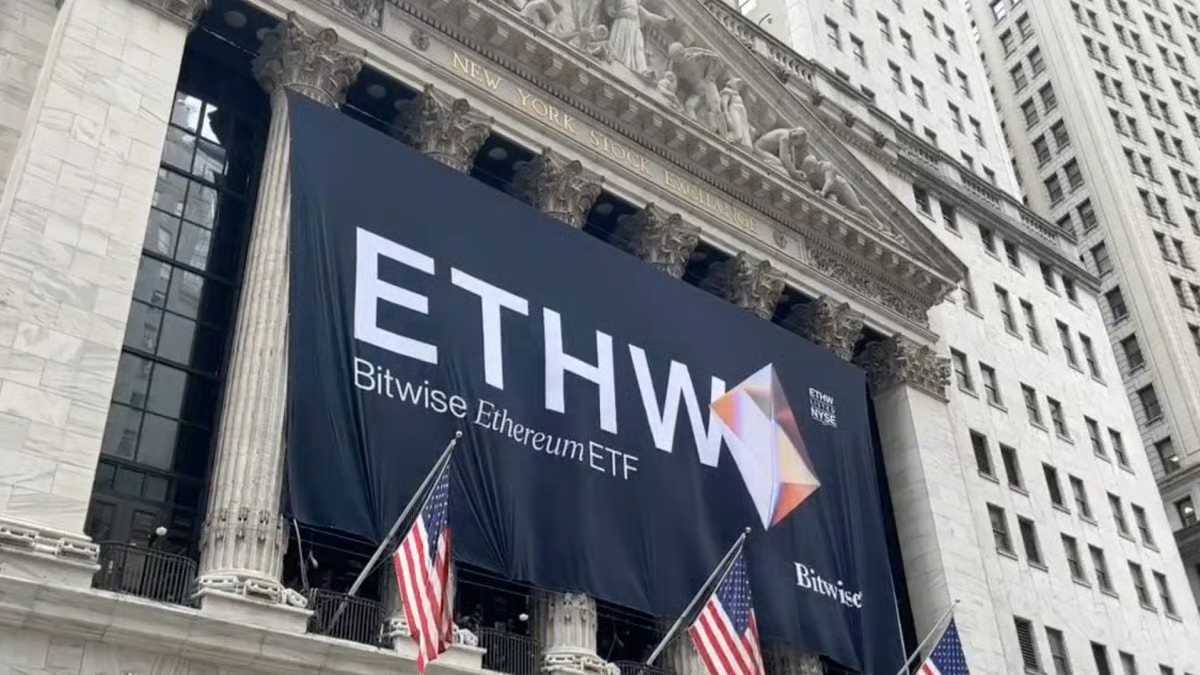

Ethereum Wall Street is no longer a theoretical concept discussed only in crypto-native circles. It has become a serious question debated inside boardrooms, regulatory hearings, and institutional investment committees: Is Ethereum quietly transforming into the new infrastructure for Wall Street itself?
For decades, Wall Street’s financial plumbing—clearing, settlement, custody, and derivatives—has relied on slow, opaque, and heavily intermediated systems. Ethereum proposes a radically different model: open, programmable, and globally accessible financial rails. But ambition alone does not make infrastructure. Adoption, trust, and resilience do.
This investigation examines whether Ethereum truly meets the requirements to serve as Wall Street’s next foundational layer—or whether its role will remain complementary rather than central.
Why Wall Street Is Looking Beyond Traditional Infrastructure
The Friction Problem in Legacy Finance
Wall Street’s core systems were built for a pre-digital era. Trades can still take days to settle. Reconciliation requires armies of back-office staff. Counterparty risk remains embedded in every transaction.
Even incremental improvements—like faster payment rails—have failed to solve systemic inefficiencies.
Ethereum Wall Street narratives gained traction because blockchain addresses these pain points at the protocol level:
- Near-instant settlement
- Transparent transaction records
- Reduced counterparty risk
- Programmable financial logic
For institutions managing trillions, even small efficiency gains can translate into billions in savings.
Ethereum’s Core Value Proposition for Institutions
Programmable Finance at Scale
Ethereum is not simply a cryptocurrency network—it is a programmable financial operating system. Smart contracts allow complex financial agreements to execute automatically without intermediaries.
In the context of Ethereum Wall Street adoption, this means:
- Automated margin calls
- On-chain collateral management
- Real-time risk monitoring
- Composable financial products
These capabilities directly challenge the relevance of legacy clearinghouses and settlement layers.
Tokenization: The Bridge Between Wall Street and Ethereum
Real-World Assets Move On-Chain
The strongest evidence supporting the Ethereum Wall Street thesis is tokenization. Major institutions are no longer experimenting—they are deploying capital.
BlackRock’s tokenized money market fund (BUIDL), launched on Ethereum, signaled a major shift. JPMorgan has used Ethereum-based networks for intraday repo settlement. Franklin Templeton runs tokenized funds on Ethereum infrastructure.
Tokenization enables:
- Fractional ownership
- 24/7 trading
- Atomic settlement
- Transparent asset tracking
Ethereum has emerged as the preferred base layer for these initiatives due to its security, liquidity, and developer ecosystem.
Ethereum vs Traditional Financial Infrastructure
| Feature | Ethereum Wall Street Model | Traditional Wall Street |
|---|---|---|
| Settlement Speed | Minutes or seconds | T+1 to T+3 |
| Transparency | Public, verifiable ledger | Opaque, permissioned |
| Operating Hours | 24/7/365 | Limited trading hours |
| Intermediaries | Minimal | Multiple layers |
| Programmability | Native smart contracts | Manual & fragmented |
| Global Access | Borderless | Jurisdiction-bound |
This comparison highlights why Ethereum is not merely an add-on but a structural alternative.
Regulation: The Biggest Barrier to Ethereum Wall Street
Compliance vs Decentralization
Wall Street does not move without regulatory clarity. Ethereum’s open nature conflicts with requirements around KYC, AML, and investor protections.
However, institutions are adapting Ethereum rather than rejecting it:
- Permissioned layers built on Ethereum
- Regulated stablecoins for settlement
- Institutional custody solutions
- Compliance-aware smart contracts
Rather than full decentralization, Ethereum Wall Street adoption is evolving toward regulated decentralization—a hybrid model that satisfies oversight without sacrificing efficiency.
Security, Stability, and the Proof-of-Stake Shift
Ethereum’s transition to Proof-of-Stake addressed a key institutional concern: sustainability. Energy efficiency, predictable issuance, and economic security improved Ethereum’s credibility as financial infrastructure.
From a Wall Street perspective, Ethereum now offers:
- Reduced environmental risk
- Strong economic finality
- Mature tooling and audits
- Battle-tested network uptime
These factors position Ethereum closer to critical infrastructure status than any other public blockchain.
Is Ethereum Replacing Wall Street—or Rewiring It?
Despite the hype, Ethereum Wall Street is not about replacing banks overnight. Instead, it is about rewiring the invisible layers beneath finance.
Wall Street firms still control capital, compliance, and client relationships. Ethereum provides a faster, cheaper, and more transparent backbone.
In this sense, Ethereum resembles the internet’s relationship to media—not the elimination of institutions, but their transformation.
FAQ: Ethereum Wall Street Explained
What does Ethereum Wall Street actually mean?
Ethereum Wall Street refers to the growing use of Ethereum as underlying infrastructure for traditional financial institutions, including settlement, tokenization, and asset management.
Is Ethereum Wall Street adoption already happening?
Yes. Major firms like BlackRock, JPMorgan, and Franklin Templeton are actively using Ethereum-based systems in production environments.
Can Ethereum Wall Street coexist with regulations?
Ethereum Wall Street adoption is increasingly compliance-focused, using permissioned layers, regulated custodians, and compliant smart contracts.
Is Ethereum Wall Street safer than traditional systems?
While risks remain, Ethereum offers transparent auditing, cryptographic security, and real-time settlement, reducing certain systemic risks.
Final Analysis: Ethereum’s Quiet Financial Takeover
Ethereum Wall Street is not a marketing slogan—it is an emerging reality shaped by institutional pragmatism rather than crypto ideology.
Ethereum may never replace Wall Street’s institutions, but it is increasingly replacing their infrastructure. Clearing, settlement, collateral management, and asset issuance are migrating on-chain—not out of ideology, but efficiency.
If the past decade was about crypto challenging finance, the next decade may be about Ethereum quietly becoming finance’s operating system.
