

Bitcoin Hash Ribbons have become one of the most influential long-term indicators in crypto trading, widely referenced by analysts, hedge funds, and long-term Bitcoin holders. Known for its rare but historically powerful “buy signals,” the indicator blends miner activity, network health, and market structure into one compelling metric. But what exactly triggers the buy signal for the Bitcoin Hash Ribbon indicator — and does it still work in today’s volatile market?
This investigative article breaks down how the signal is generated, why it works, where it fails, and how it compares to competing long-term indicators such as the Puell Multiple.
What Are Bitcoin Hash Ribbons?
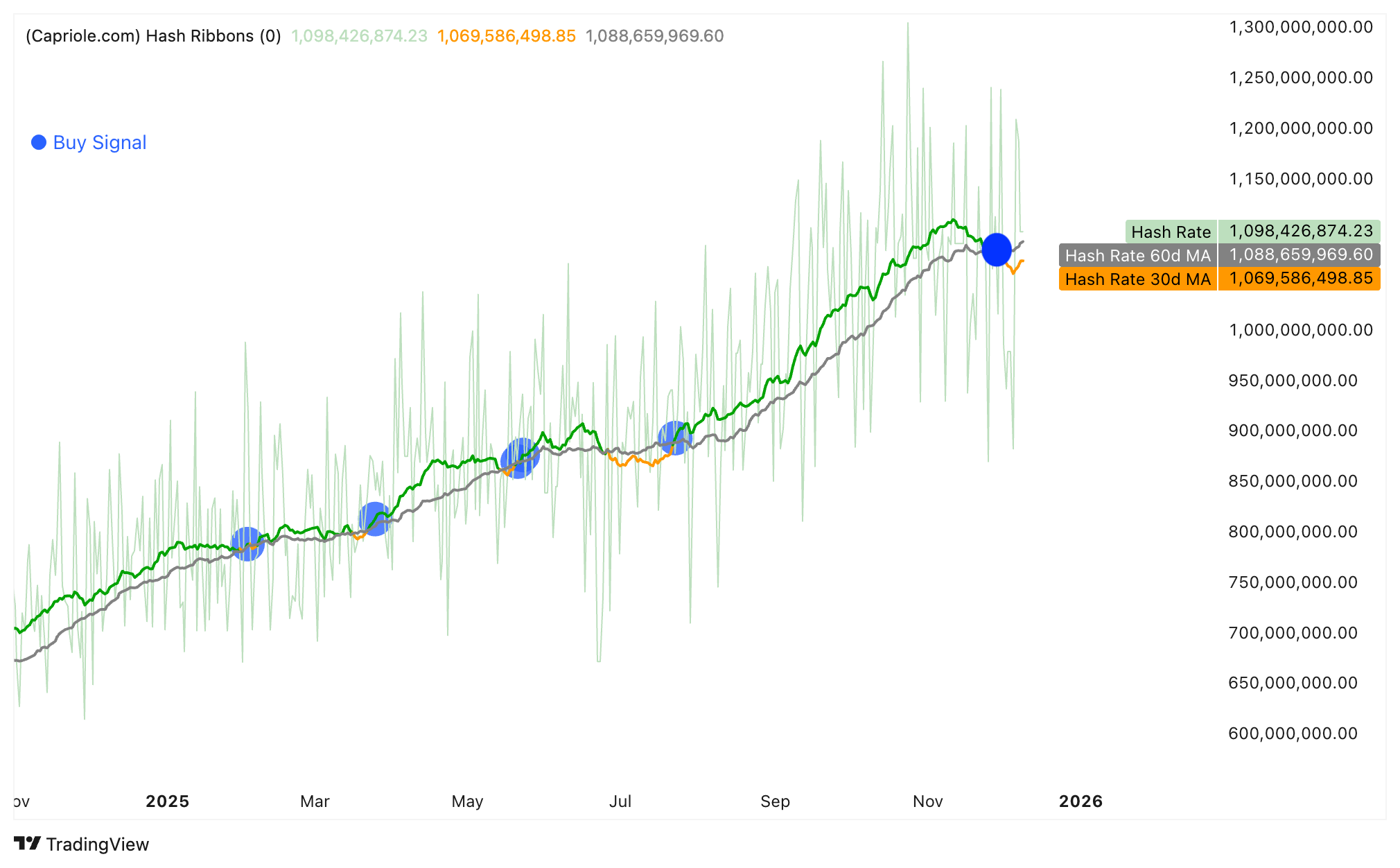
Bitcoin Hash Ribbons are a market indicator that analyzes the 30-day and 60-day moving averages of Bitcoin’s hash rate. The theory behind the indicator is rooted in miner behavior: when miners shut down machines due to unprofitability, hash rate drops — often coinciding with major market bottoms.
When the hash rate recovers, the Bitcoin Hash Ribbons detect this shift and issue a “buy signal,” suggesting miners have capitulated, weak hands have been flushed out, and the worst of the selling pressure is over.
This model was introduced and popularized by analyst Charles Edwards, who argued that miner capitulation has historically aligned with ideal long-term accumulation moments.
How the Bitcoin Hash Ribbons Buy Signal Works
The buy signal for Bitcoin Hash Ribbons is not random — it follows a specific sequence:
1. Miner Capitulation
Miner capitulation occurs when operational costs exceed mining profitability. Miners may be forced to:
- Shut down ASICs
- Sell BTC reserves
- Exit the market
- Consolidate operations
This drop in hash rate is captured when the 30-day moving average falls below the 60-day moving average.
2. Hash Rate Recovery
Once price stabilizes or difficulty adjusts downward, miners return. Hash rate begins rising again, indicating improved network health.
3. The Buy Signal Trigger
The buy signal appears when:
The 30-day MA crosses back above the 60-day MA
AND
Bitcoin price shows early recovery signals.
This recovery cross has historically appeared at or near major BTC price bottoms.
Why the Bitcoin Hash Ribbons Buy Signal Matters
The indicator is fundamentally based on miner capitulation — one of the most reliable long-term data points in Bitcoin’s ecosystem.
A Unique Combination of Technical + Fundamental Data
Unlike traditional technical indicators that rely solely on price, Bitcoin Hash Ribbons incorporate:
- Network strength
- Miner behavior
- Energy cost dynamics
- Mining difficulty adjustments
This hybrid approach gives it stronger predictive reliability than price-only indicators.
Historically Strong Returns
According to CryptoQuant and Glassnode data, past buy signals resulted in strong long-term performance:
- 2020 signal: Before BTC ran from $8K → $64K
- 2022 signal: Marked a macro accumulation zone
- 2019 signal: Before BTC rallied from $3.5K → $14K
While there are no guarantees, the historical track record draws significant attention from investors.
Does the Bitcoin Hash Ribbons Signal Still Work Today?
Some critics argue that Bitcoin Hash Ribbons may be less effective today due to:
- Institutional-level miners
- Bitcoin’s rising hashrate floor
- Financialized miner hedging strategies
- Hash rate smoothing due to global scale
However, most analysts still view the signal as a high-value long-term indicator — particularly for investors seeking accumulation opportunities during market stress.
Cross-referencing with metrics like the Puell Multiple, MVRV Z-Score, and Difficulty Ribbon Compression strengthens its reliability in modern markets.
Bitcoin Hash Ribbons vs. Puell Multiple (Comparison Table)
Below is a clean comparison table evaluating Bitcoin Hash Ribbons against a popular alternative: the Puell Multiple, which measures miner revenue relative to long-term averages.
Comparison Table
| Indicator | What It Measures | Strengths | Weaknesses | Best For |
|---|---|---|---|---|
| Bitcoin Hash Ribbons | Hash rate recovery after miner capitulation | Strong historical buy signal, captures network health, used by institutional analysts | Lagging indicator, signals are rare, sensitive to mining geopolitics | Long-term accumulation |
| Puell Multiple | Miner revenue vs. 365-day average | Identifies undervaluation, simple and effective | Can give early/false signals, doesn’t track hash rate | Macro cycle positioning |
How Traders Use Bitcoin Hash Ribbons Today
1. Long-Term Accumulation Strategy
Most traders use the signal for dollar-cost averaging and multi-year holding, not short-term speculation.
2. Identifying Miner Stress Zones
When Hash Ribbons show miner capitulation, it often precedes:
- Exchange outflows
- Difficulty adjustments
- Volatility compression
- Market bottoms
Investors use this as a macro health check for Bitcoin.
3. Combined With On-Chain Metrics
Professionals rarely rely on one metric alone. Hash Ribbons are often paired with:
- MVRV Z-Score
- Reserve Risk
- Stock-to-Flow deviations
- Difficulty Ribbon Compression
This multi-metric approach provides a stronger, more reliable picture.
Expert Opinions on Bitcoin Hash Ribbons
Charles Edwards (Capriole Investments)
“The Bitcoin Hash Ribbons buy signal historically captures capitulation fear in miners, which often aligns with long-term generational buying levels.”
Glassnode Analytics
Glassnode highlights that miner capitulation phases are rare but powerful moments where risk/reward heavily favors accumulation.
(glassnode.com)
Risks and Limitations of the Bitcoin Hash Ribbons Indicator
No indicator is perfect — and Hash Ribbons are no exception.
Market Lag
The buy signal only appears after hash rate recovers, meaning the exact bottom may have already passed.
Mining Industry Volatility
Geopolitical events — such as China’s 2021 mining ban — can distort hash rate activity and create misleading signals.
Assumption of Miner Behavior
The model assumes miners react similarly across cycles, but:
- Institutional miners hedge their BTC
- Mining firms access external capital
- Energy markets evolve
- Scaling and AI farms share infrastructure
These variables could weaken the indicator’s predictive power in the long run.
FAQ: Bitcoin Hash Ribbons Explained
Q1: What is the Bitcoin Hash Ribbons buy signal?
The Bitcoin Hash Ribbons buy signal is triggered when the 30-day hash rate moving average crosses above the 60-day moving average after miner capitulation, indicating potential market recovery.
Q2: How accurate are Bitcoin Hash Ribbons historically?
Bitcoin Hash Ribbons have historically been highly accurate for long-term accumulation, aligning with cyclical bottoms in 2019, 2020, and 2022.
Q3: What causes a Bitcoin Hash Ribbons miner capitulation event?
Low BTC prices, high energy costs, difficulty spikes, or geopolitical pressure can trigger the miner stress that leads to Bitcoin Hash Ribbons capitulation.
Q4: Do Bitcoin Hash Ribbons work for short-term trading?
No. Bitcoin Hash Ribbons are designed for macro analysis and long-term strategies, not intraday or short-term trading.
Q5: How do Bitcoin Hash Ribbons compare to other indicators?
Compared to indicators like the Puell Multiple, Bitcoin Hash Ribbons focus on hash rate recovery rather than miner revenue. Many traders use both for confirmation.
Conclusion — Are Bitcoin Hash Ribbons Still a Reliable Buy Signal?
Bitcoin Hash Ribbons remain one of the most respected on-chain indicators for identifying long-term accumulation opportunities in Bitcoin. By blending miner behavior with network health metrics, the indicator captures fundamentals that price action alone cannot reveal.
While the buy signal is rare — and not immune to shifts in global mining conditions — its historical accuracy and deep connection to Bitcoin’s economic security make it a valuable tool for institutional analysts and long-term investors.
As Bitcoin enters new cycles of institutional adoption, global mining expansion, and AI-driven energy competition, the role of miner dynamics may become even more important. And in that environment, Bitcoin Hash Ribbons could continue to serve as one of the clearest windows into the moments when the market has reached true exhaustion — and is preparing for the next major trend.
