
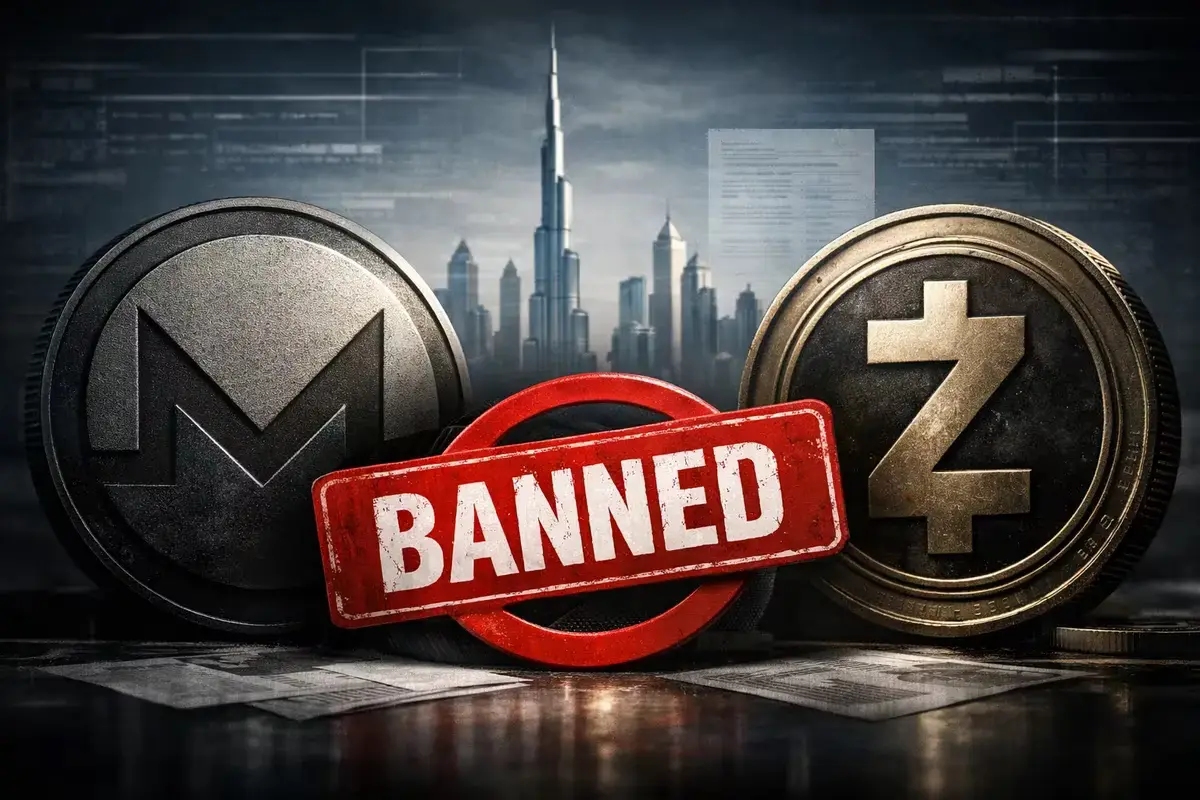

Dubai ban privacy tokens has become the defining headline of the emirate’s latest cryptocurrency regulatory overhaul, with the Dubai Financial Services Authority (DFSA) announcing a comprehensive prohibition of privacy‑focused cryptocurrencies like Monero and Zcash inside the Dubai International Financial Centre (DIFC). The move, effective January 12, 2026, also accompanies tighter rules on stablecoins and a significant shift in how digital asset suitability is determined within one of the world’s fastest‑growing crypto hubs.
What the Dubai Ban on Privacy Tokens Means
At its core, the Dubai ban privacy tokens directive stems from concerns among regulators that privacy‑enhancing features inherent in tokens such as Monero (XMR) and Zcash (ZEC) make it nearly impossible for regulated firms to comply with anti‑money‑laundering (AML) and counter‑terrorist financing (CTF) obligations. Under the updated DFSA framework, privacy tokens are prohibited from being traded, held, marketed, or used in any regulated capacity within the DIFC, the emirate’s leading financial free zone.
Elizabeth Wallace, Associate Director for Policy and Legal at the DFSA, explained that the design of these privacy tokens obscures key transaction data — including sender, recipient, and amount — rendering compliance with global standards, such as those set by the Financial Action Task Force (FATF), “nearly impossible.”
Why Privacy Tokens Trigger Regulatory Alarm
Privacy tokens were developed to offer users a higher degree of transactional anonymity than mainstream cryptocurrencies such as Bitcoin or Ethereum. For certain users, this privacy is a feature — protecting financial data from public exposure. But regulators argue that this same privacy can also be a vulnerability.
- Lack of traceability: Privacy protocols conceal key transaction details.
- AML/CTF risk: Firms must be able to identify transaction participants under FATF guidelines.
- Regulated limitation: TFIs and exchanges in the DIFC can’t efficiently monitor or report suspicious activity tied to privacy tokens.
These regulatory concerns mirror broader global trends. In the United States and European Union, policymakers are increasingly scrutinizing anonymity‑focused assets and implementing stringent compliance requirements. For instance, the EU’s Markets in Crypto‑Assets (MiCA) framework effectively excludes privacy coins from regulated markets by disallowing anonymous trading.
Stablecoins Under Stricter Scrutiny
Alongside the Dubai ban privacy tokens development, the DFSA has redefined its stablecoin regime. Under the new “fiat crypto token” classification, only stablecoins:
- Pegged 1:1 to fiat currencies, and
- Backed by high‑quality, liquid reserves capable of meeting redemption demands in stress conditions
are recognized within the DIFC. Algorithmic stablecoins — such as those that rely on hedging strategies rather than direct fiat reserves — have been excluded from this stablecoin category and are now treated as general crypto assets rather than payment instruments.
This approach seeks to protect investors and financial market stability, ensuring that stablecoins fulfilling payment and settlement roles are underpinned by transparent, reliable reserve structures.
Token Approval: From Regulator to Firms
A striking aspect of the revised framework is the shift in responsibility for token approvals. Rather than maintaining a central list of DFSA‑approved crypto assets, the regulator now entrusts licensed firms — exchanges and licensed financial entities — to assess suitability based on risk, compliance, and suitability criteria.
Proponents of this decentralization argue it will streamline innovation, allowing market participants to determine token offerings while assuming responsibility for compliance. Critics worry it may increase operational risk and compliance burdens for firms unprepared for such oversight.
How Dubai’s Direction Compares Globally
| Jurisdiction | Privacy Token Stance | Stablecoin Approach |
|---|---|---|
| Dubai (DIFC) | Banned inside regulated zone | Only fiat‑backed, liquid reserve tokens |
| European Union (MiCA) | Effectively excluded via AML rules | Permitted with strict transparency |
| Hong Kong | Allowed in theory under risk‑based licenses | Regulated with strong oversight |
| United States | Regulatory scrutiny, no formal ban | SEC/CFTC considerations vary |
This table highlights the varied global responses to privacy tokens and stablecoins — from outright bans in some regulated sectors to cautious engagement with strong compliance requirements elsewhere.
Market and Industry Reactions
Initial market sentiment was mixed at best. Despite the Dubai ban privacy tokens announcement, Monero prices surged in certain markets, reflecting a disconnect between regulatory news and speculative trading dynamics.
Institutional participants have generally welcomed clearer rules, eliminating grey areas and lowering reputational risk associated with ambiguous asset classifications. At the same time, smaller crypto firms and enthusiasts argue that restrictions on privacy coins may push trading into less‑regulated spaces or offshore platforms.
Broader Implications for Dubai’s Crypto Position
Critics suggest that banning privacy tokens could chill innovation and drive certain crypto niches away from regulated markets. Proponents, however, emphasize that compliance standards — especially in financial hubs — foster confidence among institutional capital and align with international norms.
Dubai’s focus on compliance, transparency, and robust risk management fits its broader ambition to be a leading, trustworthy hub for digital finance. The city continues to attract blockchain projects, tokenized assets initiatives, and institutional players, even as it tightens regulatory guardrails.
FAQ: Dubai Ban Privacy Tokens
Q: What exactly does the Dubai ban privacy tokens policy prohibit?
A: The policy prohibits regulated firms in the DIFC from trading, holding, marketing, or engaging with privacy tokens such as Monero and Zcash due to AML and compliance concerns.
Q: Why did Dubai ban privacy tokens like Monero?
A: Regulators argue these tokens’ anonymity features make it difficult for financial institutions to meet AML and counter‑terrorist financing obligations, as required by international standards.
Q: Does the ban apply to the whole UAE?
A: The current ban applies specifically to the DIFC. Other Dubai jurisdictions, regulated separately (e.g., VARA), already had similar restrictions but operate under distinct frameworks.
Q: Are privacy tokens illegal worldwide?
A: No. Other regions may allow privacy tokens under regulated conditions, though restrictions like AML controls vary by jurisdiction.
Q: What happens to stablecoins under the new Dubai rules?
A: Only fiat‑backed stablecoins with transparent, liquid reserves will qualify under the DFSA’s stablecoin classification. Algorithmic variants are reclassified as general tokens.
Conclusion
The Dubai ban privacy tokens decision marks an inflection point in the evolution of Middle Eastern crypto regulation, signaling a clear stance that transparency and compliance will trump anonymity in regulated markets. While this may limit certain decentralized or privacy‑focused innovations within the DIFC, it aligns Dubai with international AML norms and may enhance institutional confidence.
Looking forward, the challenge for Dubai will be balancing these regulatory priorities with the need to nurture innovation. Firms and projects that adapt to these standards — while offering robust compliance capabilities — are likely to thrive, whereas privacy‑centric assets may find their most fertile ground in less centralized or regulated ecosystems.
